


Remarkably, the Singapore Sling was the first cocktail I ever sipped, although it cost far less than $40 and came in a plastic cup in the bar at Greek Peak—a Central New York ski area where my college ski club went weekly every winter. I tried it because a particularly pretty co-ed was enjoying one, so I asked her what it was—you know…to break the ice. The conversation pretty much ended there, but my cocktail habit didn’t.
That memory lay fallow for decades; while I developed an early preference for gin drinks (especially the dry Martini), I didn’t look up the Singapore Sling recipe until several years ago, when I decided to serve it as a sample cocktail during one of my spirits tasting events. Unsurprisingly, it turned out to be a crowd pleaser, and with this leg up from the New York Times it may be headed for a moment. The article is excellent; a regular reader of my blog will know I’m as interested in the history and culture behind cocktails as I am in the drinks themselves, and the Times’ Nicholas Yong delivers all of that. While the Long Bar’s $40 price for a sling is a little breathtaking, I’m reminded of what what the late, great bartender Sasha Petraske is credited with saying: “The drinks are free; guests pay for the hospitality.”
“The Long Bar, located in the 139-year-old Raffles Hotel, is dominated by a spiral wooden staircase, where gunnysacks of groundnuts were placed. Overhead, mechanical punkah ceiling fans — historically operated by hand — created a gentle breeze. A poster outside the bar urged customers to “imbibe like a plantation owner in the early 1900s.”
“A hand-cranked, cast-iron cocktail mixing machine, called the Sling Shaker, which can shake up to 18 Slings at once, was also a big draw for customers. Despite its vintage look, it was installed only in 2018 — and the shakers are sometimes not even filled when the machine is operating.”
A bit further into the article:
“According to Raffles Hotel’s official history, the Sling was invented in 1915 by the Hainanese bartender Ngiam Tong Boon, initially as a means for respectable ladies to disguise the fact that they were drinking in public. The cocktail’s ingredients include cherry liqueur, pineapple juice, Cointreau and gin. A life-size cutout of Ngiam now stands at the Long Bar entrance.”
Coincidentally, Ngiam Tong Boon is also the sound a college student makes when falling off a bar stool after a half-dozen or so après-ski Singapore Slings. Or so I’ve read.
THE SINGAPORE SLING RECIPE
1 oz Gin
¼ oz Benedictine
¼ oz Cointreau or Grand Marnier
¼ oz Heering Cherry Liqueur
1 oz Pineapple juice (freshly squeezed, or Dole 100% Juice)
½ oz Lime juice (freshly squeezed)
1 dash Aromatic bitters (e.g., Angostura)
Club soda to top off
Lime wheel & cherry to garnish
Add all ingredients to a cocktail shaker mostly full of ice. Shake hard and pour into a chilled, ice-filled highball, Collins, or Hurricane glass. Top with club soda and garnish.
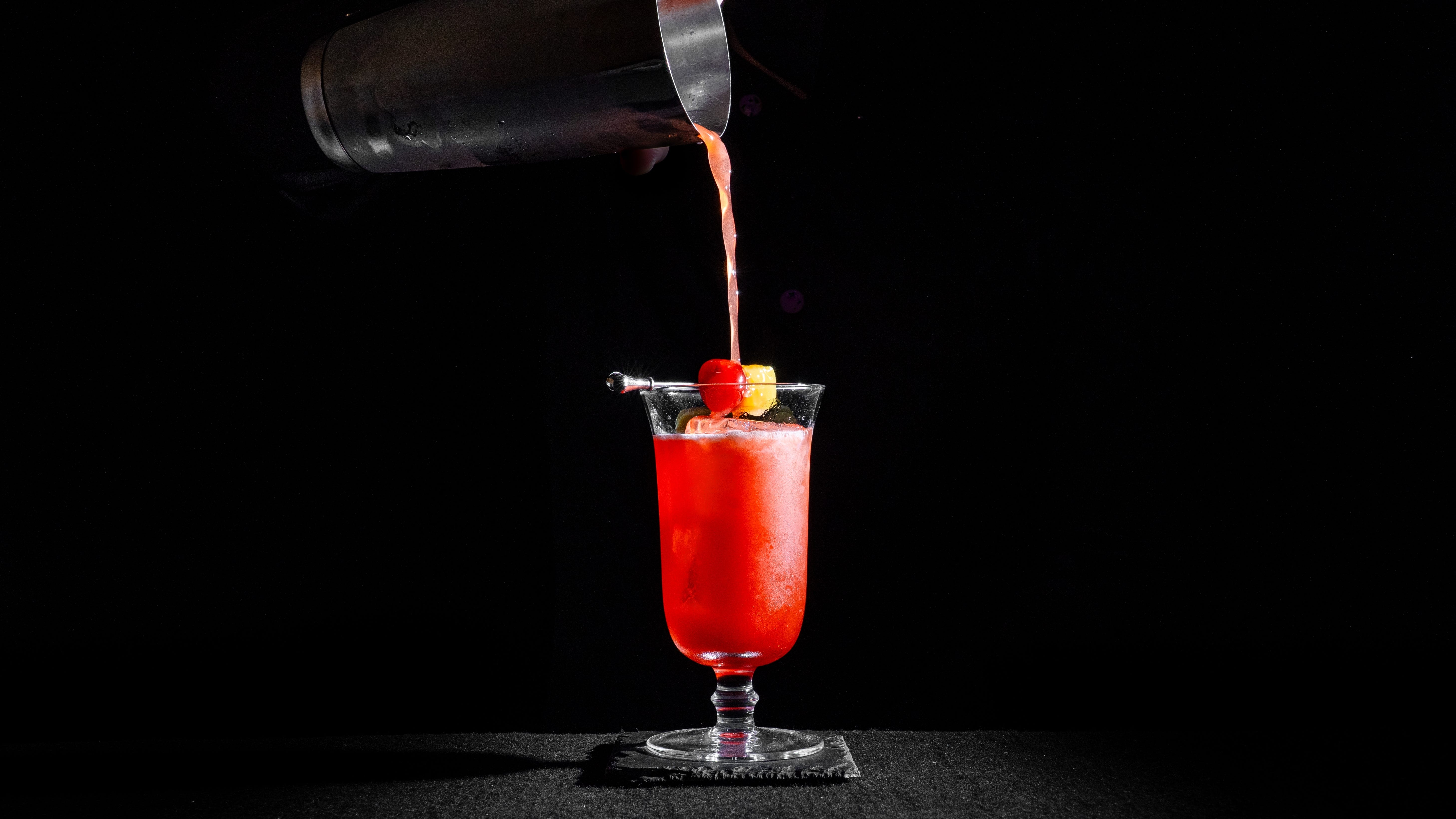
Tony, first I apologize for taking this long to reply. I promise to do better. Also, I need to confess that the photo in my post is a stock photo I licensed from Shutterstock (and far better than I'd do here in my home), so I've no idea exactly what ingredients the photographer used in that lovely drink.
As to the recipe: You're right that the original recipe and most variations on it call for cherry liqueur. Most commonly it would be a quarter-ounce of Cherry Heering liqueur, although cocktail historian David Wondrich says that very early recipes may have used clearer cherry brandy ingredients such as kirschwasser. I don't think a mere quarter-ounce of Cherry Heering would color the drink very much, and it's possible that the photographer included a dose of grenadine, which is also red (depending what your buy or how you make it) and appears in some Singapore Sling recipes as well.
The backstory on the recipe I included in the post is that I first mixed it to include in a gin tasting I did in a small local shop that didn't carry Cherry Heering, and in retail tastings I won't ever include an ingredient the shop doesn't carry. Presenting the cocktail anyway was a judgment call; I like my cocktails on the drier side and enjoyed the cherry-free version, so I went with it. I'll add the Cherry Heering back to the recipe, though, since it's almost always in the drink. In my haste to get that post out, I forgot that I'd varied from the traditional recipe.
All of that said, the noted bartender Jeffrey Morgenthaler (whose recipe for grenadine I make, BTW) says this in a blog post about his favorite Singapore Sling recipe, which happens to omit pineapple juice entirely:
"I’ve never seen a cocktail with as many variations as the Singapore Sling. Even David Embury was inspired to report, in his The Fine Art of Mixing Drinks from 1948, “Of all the recipes published for this drink, I have never seen any two that were alike.” Never mind the fact that nobody can seem to agree on the exact proportions or whether or not the drink actually contains pineapple juice, even the agreed-upon ingredients themselves are under question. Is it Cherry Heering, cherry brandy, kirschwasser, or some other cherry-flavored variant?"
https://jeffreymorgenthaler.com/my-favorite-singapore-sling-recipe/
Shouldn't there be cherry liqueur listed in the recipe? It is listed as an ingredient within the article, and the photo shows a bright red cocktail that would not look that way with only the ingredients listed in the recipe.